Method of supplying Artificial Noses.
Account of the Method of supplying Artificial Noses; as practiced by the Natives of the Malabar Coast.
MOST of our readers have no doubt heard of the formation and adaption of artificial Noses. In Europe this operation has been generally considered as visionary, and has afforded a fine theme for the ridicule of some of our wits of the first order. For example, Addison, Steele, and Pope, have not overlooked the art of famed Taliacotius. This art, it appears, is actually practiced, and with great success, in the western parts of India, by a caſt of Hindoos, called Kamoos. An account of their method of performing this operation appears in a paper published in the Bombay Courier of the 4th April 1795, which we have extracted for the information of the curious:
“It is much to be lamented that the Europeans, whose talents have been devoted to the literature of India, have applied themselves rather to the speculative than to the practical parts of knowledge; and that their discoveries, however meritorious, have been more curious than useful.
“Although we cannot agree with those who look to India as the source from whence Europe has derived every thing that is valuable in science, yet we must allow that it has been the fountain of much of our knowledge; and that the common practice of the necessary arts of life among an ancient people would yet afford us not a little instruction.
“The progress that has been made in surgery for several centuries past in Europe makes it little probable that any improvement could be expected from the natives of this country; but we think, that in two operations we may still receive instruction. The first of theſe is the depression of the chrystalline lens, when it becomes opake; and the second, the formation of noſes. We may alſo remark, that with instruments far more imperfect than ours, they perform the operation of Lithotomy in the very place which, by the consent of modern surgeons, is esteemed the best.
“The Hindoos certainly deferve the praise of making artificial noſes in a fuperior way to any people in the world; an art, unfortunately for them, the more neceffary, as in no part of the world is the practice of cutting off nofes fo common. The process of repairing them was recommended in Europe about three hundred years ago, and was faid to have originated with the Calabrians, from whom it was received by the surgeons of Bologna.
“The celebrated Taliacotius, so unjustly exposed by some of our wits to ridicule, wrote a volume on those unions of living matter, under the title of “Chirurgia curtorum per Insitionem Membrorum.” We have never had access to this work; but we have reason to think, from the following extract from Fabricius ab aquapendente, that the operation in Europe was much inferior to the one in uſe in this country.
‘And yet, if all the cartilage of the bone is cut off, a wound of this kind is incurable. But that so great a deformity may not appear on the face, art has found out the method of repairing what is lost. The first who have taught us the mode of repairing noses, were the Calabrians, from whom it soon passed to the Bologna physicians. But the mode is ſo laborious, tedious, and difficult, that those who have once submitted to it, would never be willing to experience it again, if their nose required further repairs. A portion of the pinnæ nasi is first scarified; then an incision is made in the skin of the arm equal to the portion of nose that is wanting; the parts of the arm and nose are then sewed together; the arm is now tied to the head, and fixed immoveably, for the least motion would hinder the adhesion. When this is once effected, the nose is again wounded with deep and repeated scarifications, so that the red flesh may be feen and the scar destroyed. The part of the arm to which it is affixed, is to be cut into and formed; the nose is to be sewed; and this is to be often repeated, until the whole noſe is scarified, and the skin of the arm entirely removed from it, and made to adhere to the nose. I could write more fully on this matter, but leave it to the professor of the art, who is about to give us a large volume on the subject.’
“From the above curious paſſage it will be observed, that the object could not be effected until an adhesion had taken place between the arm and the mutilated nose; and we may readily conceive, that an operation so long and painful would soon fall into disuse.
“We have seen a letter from Mr. Lucas, an ingenious surgeon of Madras, describing very particularly the operation of putting on noses, which in one cafe he himself performed with success. This differs but little from the Indian method practiced by the Koomas, a cast of Hindoos, with which, as it has been ably described by a gentleman who witnessed the process, we shall conclude theſe observations.
“Some religious ceremonies are first performed: beetel and arrack put into the patient’s hands, he is then laid upon his back, his arms stretched along his fides on the ground, he is ordered, on no pretence whatever, to raise his arms during the operation; and they impress him with the idea, that it cannot be successful unless he complies strictly with theſe injunctions. A plate of wax being previously formed into the shape of the defective noſe, it is flattened and laid obliquely upon the forehead, so as to avoid the hairy scalp. The ale and septum of the artificial nose being placed upwards, the other extremity of it terminating at the indentation of the ossa nasi with the os frontis, the operator marks out a portion of integuments equal to the size of the flattened wax, and then dissects it from the pericranium, leaving a small slip undivided between the eye-brows, to preserve the circulation in the detached piece until an adhesion takes place between it and the stump of the nose. He then cuts or pares off the cicatrix from the stump of the nose; and immediately behind the excision he makes an incision, into which the edge of the integuments are to be grafted or inserted.
“As there remains a flip of tegu- ments between the eye-brows undivided, the detached portion, when turned down, is twisted half round; so that its recent surface may be ap- plied to the face of the scarified ſtump, and the edge grafted into the above described incision, which extends along both alæ to the superior part of the upper lip; a transverse incision is also made in the superior part of the upper lip, into which the septum is inserted. Thus carefully grafting or inserting the scalp, it is kept exactly in this situation by a cement, called in this country Kitta, which is softened with a little water, and spread on long narrow bits of cotton cloth; five or fix of which are applied over each other upon the junction which forms an irregular triangle. The dressing for the wound on the forehead is pieces of cloth dipped in ghee; the patient is desired to lie on his back five or six days. Four days after the operation the cement is removed, and the junction only covered with cloth moistened in ghee or oil, which is renewed every day: neither stitches, sticking plaister, compress, nor bandages, are required. About ten days after the operation, round dossils, made of soft old cloth, are introduced into the nostrils to prevent them from contracting too much, which would happen if this precaution were neglected.
“The connecting slip of integuments is generally divided about the 25th day; and on this occasion some more dissection is necessary, to effect an exact union, and to leave as little seam as possible on the superior part of the arch of the nose.”
-(CHARLES BROCKDEN BROWN, 1798)
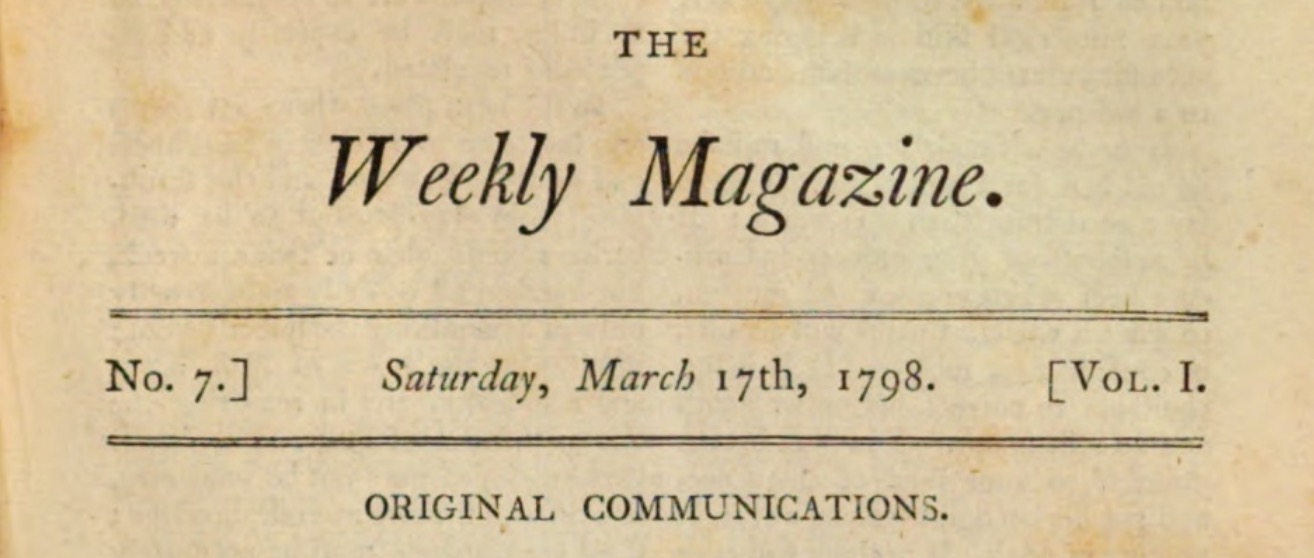
[THE WEEKLY MAGAZINE; NO. 7; VOLUME I; SATURDAY, MARCH 17, 1798]
ORIGINAL 1798 ARTICLE:


SANTO’S ARTICLES AND BOOKS OF CHARLES BROCKEN BROWN
Leave comment